

 Hungarian
 Roman

Csíkkarcfalvi római katolikus vártemplom
Csik chair Cârța Cârța
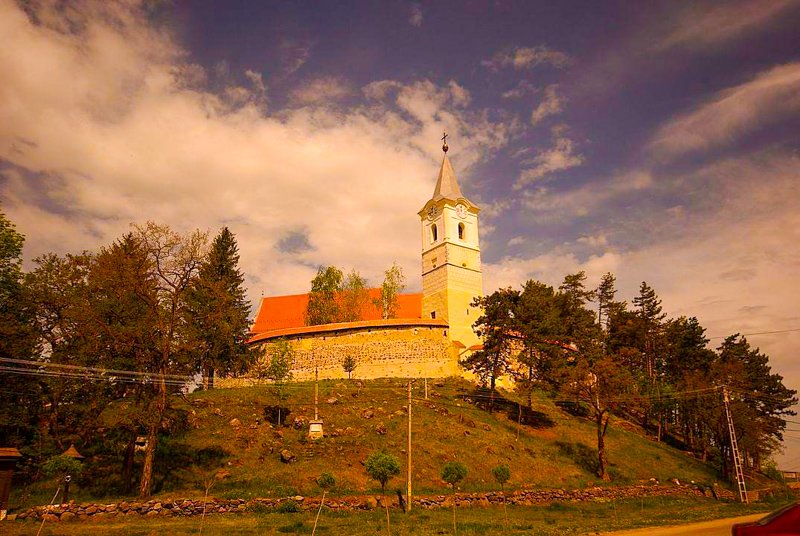
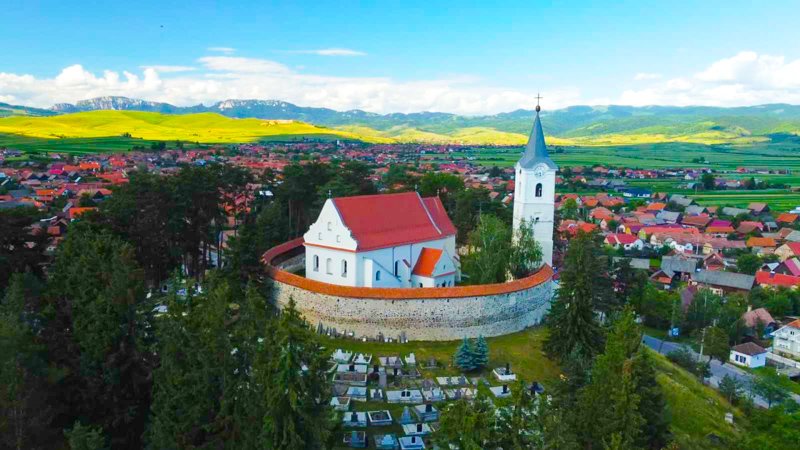
On a rocky outcrop of Madics Hill, on the border of Karcfalva and Jenőfalva, rises the most picturesque fortified church of the Csík district. The faith and strength of four villages brought this church into being sometime in the early 1300s. The people of Dánfalva broke the stones here, the carters of Jenőfalva hauled them, and the folk of Csíkmadaras and Karcfalva built the walls. This is how the first church, dedicated to the Assumption of the Virgin Mary, was erected and rose upwards.
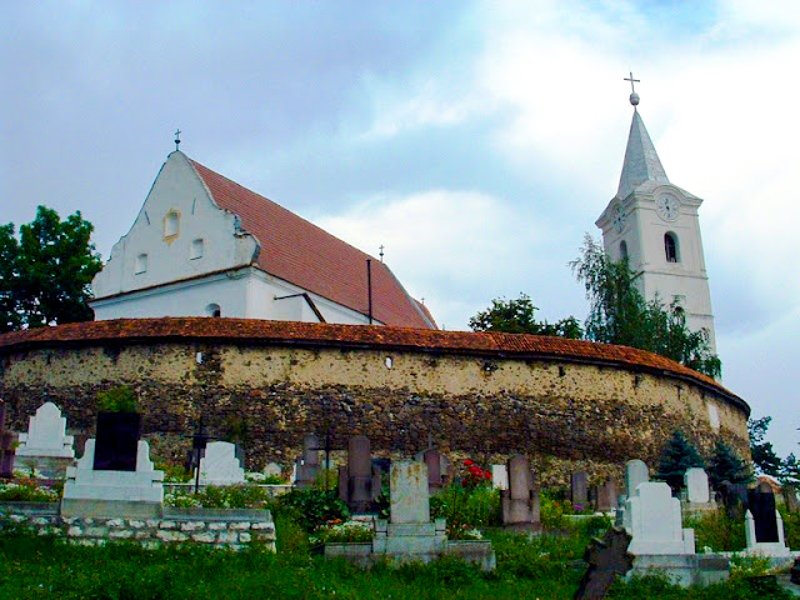
The church, built on a rocky height, naturally offered itself as a refuge, and so in the 15th century a defensive wall was built around it. To defend it, a two-storey tower was erected, which also served as a bell tower. On foundations two metres thick, walls of roughly four fathoms—seven to eight metres—were built of quarried stone. The eastern part of the fortified church was protected naturally by the steep, rocky slope. On the western side, where the hill meets Madicsa, a second line of defence was also constructed, consisting of a deep ditch and a wall. Even Balázs Orbán saw only its traces. It is possible that this outer wall served to protect livestock during a siege. The history of the defensive wall surrounding the church is still unclear; it was most likely built around the 16th century. Balázs Orbán considers it probable that the wall was constructed against Turkish incursions, so that the inhabitants of the Upper Olt region could find shelter there.
The defence of the fortification was further enhanced—and its gatekeepers protected from firearms—by a thin shield wall or barbican built in front of the entrance, probably in the 17th century. The originally arched gateway opening of the tower, facing outward, was narrowed to the width of a door for defensive reasons. To the left of the entrance, an embrasure was opened.